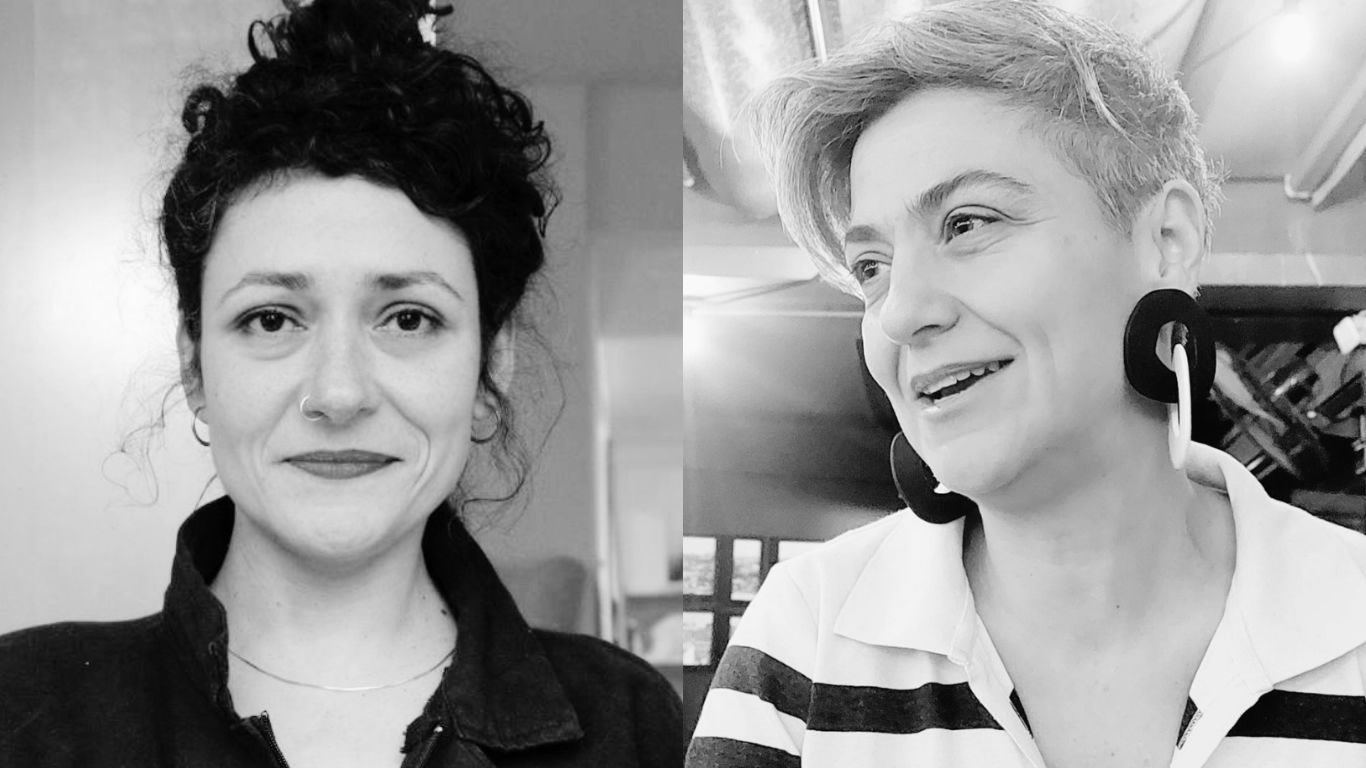
Yaşam Şaşmazer and Sibel Yardımcı will come together for a conversation exploring alternative ways of thinking about the body and the world, taking as their starting point “Udagan”, a work by Şaşmazer featured in Hara’s current exhibition “The Promises of Monsters”.
The conversation will begin with the body and its boundaries. “Udagan” presents a body in which botanical elements, prosthetics and various materials come together. Rather than appearing as a self-contained, unified form with clearly defined boundaries, this body suggests a fragmented and transformable corporeality that resists binaries such as human/non-human or female/male. Here, wounds and prosthetics do not signify a deficiency in relation to the “normal” body; instead, they point to the body’s vulnerability, its capacity for transformation and its multiple ways of being.
From this point, the conversation will open up to other ways of imagining both the body and the world. The word “udagan”, meaning female shaman, is thought to be etymologically related to words such as od (fire), ot (plant/herb) and otamak (to heal). In this sense, “Udagan” creates a space for thinking through alternative forms of knowledge that exist beyond the rational and anthropocentric epistemologies of the West: forms of knowing rooted in a closeness to nature, feminine ways of knowing, and cosmologies in which the boundaries between humans, animals, plants and spiritual beings are configured differently.
The event is free to attend. To register, please email [email protected]. Admission to Hara is free for visitors with a confirmed registration.
Sibel Yardımcı
Sibel Yardımcı has been a faculty member in the Department of Sociology at Mimar Sinan Fine Arts University since 2004. She completed her PhD in the Department of Sociology at Lancaster University. Her doctoral dissertation, “Küreselleşen İstanbul’da Bienal”, was published by İletişim in 2005.
Yardımcı contributed to publications such as “Sakatlık Çalışmaları” (Koç, 2011), “Queer Tahayyül” (Sel, 2013) and “Türkiye’nin Etnik Coğrafyası: 1927-1965 Ana Dil Haritaları” (MSGSÜ, 2015). She also authored a monograph on Bozcaada, published under the “2 Mahalle 1 Ada” (Literatür, 2021). Her other publications address a range of topics, including urban studies, nationalism, biopolitics, queer theory, disability studies and posthumanist thought.
Yaşam Şaşmazer
Yaşam Şaşmazer (b. 1980, Istanbul) explores the interrelationships between humans, non-human beings and nature. Working primarily with natural materials such as wood, clay and paper, she creates sculptures and installations that frequently incorporate organic and found elements. Through her use of organic materials and her engagement with time-dependent, ephemeral and decaying processes, she makes visible the ambiguity and fluidity of boundaries.
Through bodies in which human and non-human qualities merge, intertwine and transform, she engages with binaries such as human/non-human, living/non-living and organic/inorganic. In doing so, she constructs narratives that critically question the central position from which humans situate themselves within the world.
Şaşmazer’s most recent solo exhibition took place in 2025 at Zilberman Gallery in Berlin. Her works have been featured in exhibitions at institutions including Arter (Türkiye), Meşher (Türkiye), Odunpazarı Modern Museum (Türkiye), Kunstmuseum Ahlen (Germany), Künstlerhaus Palais Thurn und Taxis (Austria), Havremagasinet (Sweden), Hälsingland Museum (Sweden), Torrance Art Museum (USA), Museum Schloss Moyland (Germany), Kunstverein Ingolstadt (Germany) and Saatchi Gallery (United Kingdom).